

Finding and Targeting Long-Tail Keywords: A Complete Guide
If you’re new to SEO and want a clear starting point, you should first check out this Keyword Research guide. It’ll help you understand the basics before diving into more advanced strategies.
You’ve watched a dozen YouTube videos and read countless blog posts about SEO. Everyone makes it sound simple, but when you actually try to apply it, it’s not so easy. Despite your efforts, nothing happens.
Your content sits there, invisible, while you wonder if you’re missing something obvious.
Here’s the truth: Long-tail keywords make up 70% of all searches on Google, and they convert 2.5 times better than broad keywords. What does that mean for you? While everyone else is competing for impossible-to-rank terms like “SEO” or “marketing,” you can target specific phrases that real people are searching for right now and actually start getting traffic within weeks, not years.
This guide will show you exactly how to find long-tail keywords that real people are searching for, and how to rank for them without needing expensive tools or a computer science degree.
What Are Long-Tail Keywords?

Long-tail keywords are targeted search phrases that contain three or more words. In other words, they’re the specific things people type when they know exactly what they want.
Think about how you search. When you want something specific, you don’t just type “laptop.” Instead, you type something like “best budget laptop for graphic design under $800.”
That’s a long-tail keyword. And here’s why it matters to you: long-tail keywords have lower search volume but higher intent, making them easier to rank for.
While your competitors are fighting over “SEO tips” (a broad, impossible-to-rank-for keyword), you can dominate searches like “SEO tips for small business websites with no budget” and actually get traffic.
Here’s the key difference:
Short-tail: “running shoes” (1.2 million searches, impossible competition) Long-tail: “best running shoes for beginners with knee pain under $100” (lower searches, way easier to rank)
The person searching for that specific phrase? They’re very close to making a purchase. That’s your customer. That’s your traffic. That’s how you start winning.
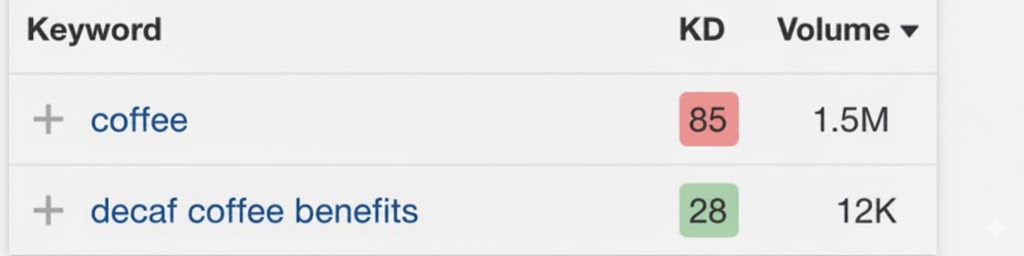
Examples of Long-Tail Keywords
Let me show you what these actually look like in the real world.
E-commerce example:
Instead of: “headphones” Target: “noise cancelling bluetooth headphones for studying under $150”
Blog content example:
Instead of: “digital marketing” Target: “digital marketing strategies for small businesses without a team”
Service-based example:
Instead of: “graphic design” Target: “affordable logo design services for new online stores”
Question-based example:
Instead of: “WordPress security” Target: “how to protect WordPress site from hackers for beginners”
See the pattern? The more specific you get, the better you understand exactly what someone needs. Furthermore, when you know what they need, you can create content that actually helps them.
Types of Long-Tail Keywords
Not all long-tail keywords work the same way. However, understanding these five types will help you select the most suitable ones for your content.
1. Support Long-Tail Keywords
These are less popular variations of more popular search queries. Essentially, they’re basically the same topic, phrased differently.
For example:
- “bedroom furniture chests”
- “dressers for bedroom”
- “wooden chest of drawers”
These all target the same thing. In fact, Google understands that different people phrase searches differently while looking for the same thing, so pages ranking for one often rank for all variations.
When to use them: When you’re already targeting a central topic and want to capture different ways people search for it.
2. Topical Long-Tail Keywords
Topical long-tail keywords are the most popular way to look for a given topic. In particular, they are topics in themselves, not just variations of something broader.
Examples:
- “how to start a podcast with no experience”
- “meal prep ideas for college students on budget”
- “WordPress plugins for beginners 2025”
These represent specific topics people want to learn about. As a result, they’re your goldmine for creating content.
When to use them: When building pillar content or comprehensive guides that can rank for multiple related searches.
3. Comparison Long-Tail Keywords
These help people decide between options. Moreover, if you check the “versus” section for your keyword, you’ll be surprised by how many people do searches about X vs Y.
Examples:
- “Shopify vs WordPress for online store”
- “free email marketing tools vs paid ones”
- “iPhone vs Android for content creators”
When to use them: When creating review content, buying guides, or helping your audience make informed decisions.
4. Question-Based Long-Tail Keywords
Question-based queries make for great long-tail keywords. Additionally, they mirror exactly how people ask for help.
Examples:
- “How long does it take to learn SEO?”
- “What is the best time to post on Instagram?”
- “Why is my website not showing up on Google?”
When to use them: Perfect for blog posts, FAQ sections, and content that directly answers specific problems your audience has.
5. Commercial Long-Tail Keywords
These are commercial-based terms that bring users closer to a business, turning them into leads.
Examples:
- “Affordable web design services for startups”
- “Best SEO course for complete beginners”
- “Freelance writing platforms that pay well”
When to use them: When you’re creating content designed to convert visitors into customers or clients.
How to Find Long-Tail Keywords
You don’t need expensive tools or technical skills to find powerful long-tail keywords.
Before diving into long-tail methods, it’s essential to know the importance of seed keywords, because seed keywords act as the foundation from which most long-tail ideas are generated.
In fact, everything you need is already available to you, completely free of charge. Let me show you five practical methods you can start using today.
1. Use Google Autocomplete
Google Autocomplete makes keyword research easy and completely free. As you start typing in Google’s search bar, it actively suggests complete phrases based on real searches. Nevertheless, these suggestions aren’t random; Google generates them from what millions of people search for every day.
How to do it:
- Go to Google (use incognito mode for unbiased results)
- Start typing your main topic
- Watch what Google suggests
Try typing “how to start” and see what appears. Importantly, each suggestion is a long-tail keyword that people are actually searching for.
Pro tip: Try adding different letters or words after your main keyword to get varied suggestions. For instance, type your keyword, then add “a,” “b,” “c,” etc., to discover more variations.
2. Check “People Also Ask”
People Also Ask queries are found right below the first organic listing. Here’s what makes them valuable: click on a question to see the answer, along with new query suggestions at the bottom.
How to use it:
- Search your main topic on Google
- Find the “People Also Ask” section
- Click on questions to reveal more questions
- Note questions that match your content goals
Each question represents a specific problem someone wants solved. Consequently, that’s your content opportunity.
3. Use Free Tools
You don’t need to spend money to find great keywords. Fortunately, here are three powerful free tools that provide keyword suggestions, traffic estimations, and competition analysis at no cost. When you enter a broad keyword, the tool generates a comprehensive list sorted by search volume and SEO difficulty.
AnswerThePublic: A fully fleshed-out keyword research tool that focuses on question-based keywords, includes keyword search volume and CPC (cost per click) data, and generates nice visualisations. Overall, this tool helps you find some of the most common questions and phrases once you enter your keyword of choice.
Keyword Tool (keywordtool.io): Similar to Ubersuggest, it provides extensive long-tail variations. However, the free version includes keyword ideas, although you’ll need to check search volumes separately.
4. Analyse Competitor Blogs
Your competitors have already done some of the work for you. In fact, if you repeat this with 5-10 of your competitors’ websites, you’ll mine enough long-tail keyword ideas to keep you busy for months.
How to do it:
- Find 3-5 competitors ‘ rankings for topics you want to cover
- Look at their blog titles and headings
- Note which specific issues they’re targeting
- Find gaps where they haven’t created content
You’re not copying their content. Instead, you’re identifying what topics work in your niche, then creating better, more helpful content around those topics.
5. Check Reddit and Quora
This is where you find keywords that tools might miss. Specifically, Reddit and other user forums help find question-based long-tail keywords. Furthermore, these are incredibly specific, intent-rich, and easy to rank for because you’re solving an exact problem.
How to use them:
- Go to relevant subreddits or Quora topics in your niche
- Read the questions people are asking
- Note how they phrase their problems
- Look for recurring themes
For example, browsing the “marketing” topic on Quora revealed that “marketing manipulation” is actually a long-tail keyword with a low difficulty score.
Pro tip: Pay attention to the words they use; it’s often more conversational and natural, which also helps with semantic SEO.
How to Rank for Long-Tail Keywords
You’ve got your keywords. Now comes the part that separates people who know about SEO from those who actually know precisely how to rank for the long-term keywords you’ve found.
1. Target One Specific Search Intent
Every keyword has an intent. Typically, people either want to learn something (informational), buy something (transactional), or compare options (commercial).
Don’t try to be everything at once. Instead, create unique, helpful content that addresses the target user’s precise wants.
If someone searches “how to create an email newsletter,” they want a step-by-step guide, not a sales page for your email service.
Match the format to the intent:
- How-to queries → Tutorial format
- Best/top queries → List or comparison format
- What are queries → Comprehensive explanation
- Where to buy queries → Product recommendations
2. Use the Keyword in the Title, URL, and Intro
Try to naturally incorporate keywords into your page’s title tag, heading tags, alt tags, and body content. Important note: Natural. Not stuffed.
Where to place your long-tail keyword:
- Page title (H1): Front-load it if possible
- URL: Keep it short and include the keyword
- First paragraph: Use it within the first 100 words
- Subheadings: Naturally include them in H2s and H3s
Ideally, it’s better to outline your content before writing in a way that is intuitive and flows, incorporating keywords naturally.
3. Add Related Supporting Keywords
Don’t just use your primary keyword once and call it done. Instead, use multiple secondary keywords where appropriate. Essentially, these search terms are related to the primary keyword and the topic.
If your primary keyword is “best budget laptops for students,” related keywords might be:
- “affordable student laptops”
- “cheap laptops for college”
- “student laptop deals”
- “budget-friendly computers”
Google understands semantic relationships. Therefore, using related terms helps search engines understand your content’s depth and relevance.
4. Use Clean Headings
Make your content scannable. In reality, most people don’t read every word; they scan for what they need.
Structure your content like this:
- Use descriptive H2s and H3s
- Break up long paragraphs (3-4 sentences max)
- Include bullet points for lists
- Add short paragraphs for easy reading
This isn’t just for readers. Additionally, search engines also use your headings to understand your content structure and relevance.
5. Link to Other Pages
Link to long-tail pages of your content from related pages on your site. Specifically, internal linking helps Google understand how your content connects and which pages are most important.
How to do it right:
- Link to related blog posts naturally within your content
- Use descriptive anchor text (not “click here”)
- Link to 2-3 relevant internal pages per article
- Make sure links add value for readers
For example, if you’re writing about email marketing for small businesses, link to your article about building an email list or creating email templates.
6. Make Content More Helpful Than Competitors
Creating better content than your competitors is where you gain an edge. Therefore, only choose keywords that complement your topical expertise. Your goal isn’t just to rank; it’s actually to help people solve their problems.
How to be more helpful:
- Add real examples, not generic advice
- Include screenshots or visuals
- Share personal experiences or case studies
- Answer follow-up questions readers might have
- Update your content regularly with fresh information
Search “best SEO tools” and look at the top results. Now ask yourself: how can I make this more helpful? For instance, you could add a comparison chart, video tutorials, or pricing breakdowns that they don’t have.
That’s how you rank, not by gaming the system, but by being genuinely more useful.
People Also Ask
How long does it take to rank for long-tail keywords?
It depends on your website’s authority and competition, but long-tail keywords typically rank faster than broad terms. In fact, some can rank within weeks, especially if your content directly answers the search query and you’re targeting low-competition keywords.
Do I need expensive tools to find long-tail keywords?
No. Google Autocomplete, People Also Ask, Ubersuggest (free version), and AnswerThePublic give you plenty of keyword ideas without spending money. Overall, these free tools are enough to build a solid keyword strategy.
How many long-tail keywords should I target in one article?
Focus on one primary long-tail keyword, then naturally incorporate 3-5 related supporting keywords throughout your content. However, don’t force it. If your content is comprehensive and helpful, you’ll naturally cover associated terms.
Are long-tail keywords still effective in 2025?
With around 8.4 billion voice assistants expected in 2025, long-tail keywords are more important than anticipated, as they closely mirror conversational queries. Clearly, they’re not going anywhere.
Can accurately reflecting long-tail keywords help me get a job in digital marketing?
Yes. Understanding keyword research is a fundamental skill employers look for. Moreover, being able to find and target long-tail keywords shows you understand user intent, content strategy, and practical SEO – skills that translate directly to ROI for businesses.
If you want to strengthen your keyword strategy even further, make sure to know the basics of LSI Keywords; it’ll help you understand how semantic relevance boosts your rankings.