
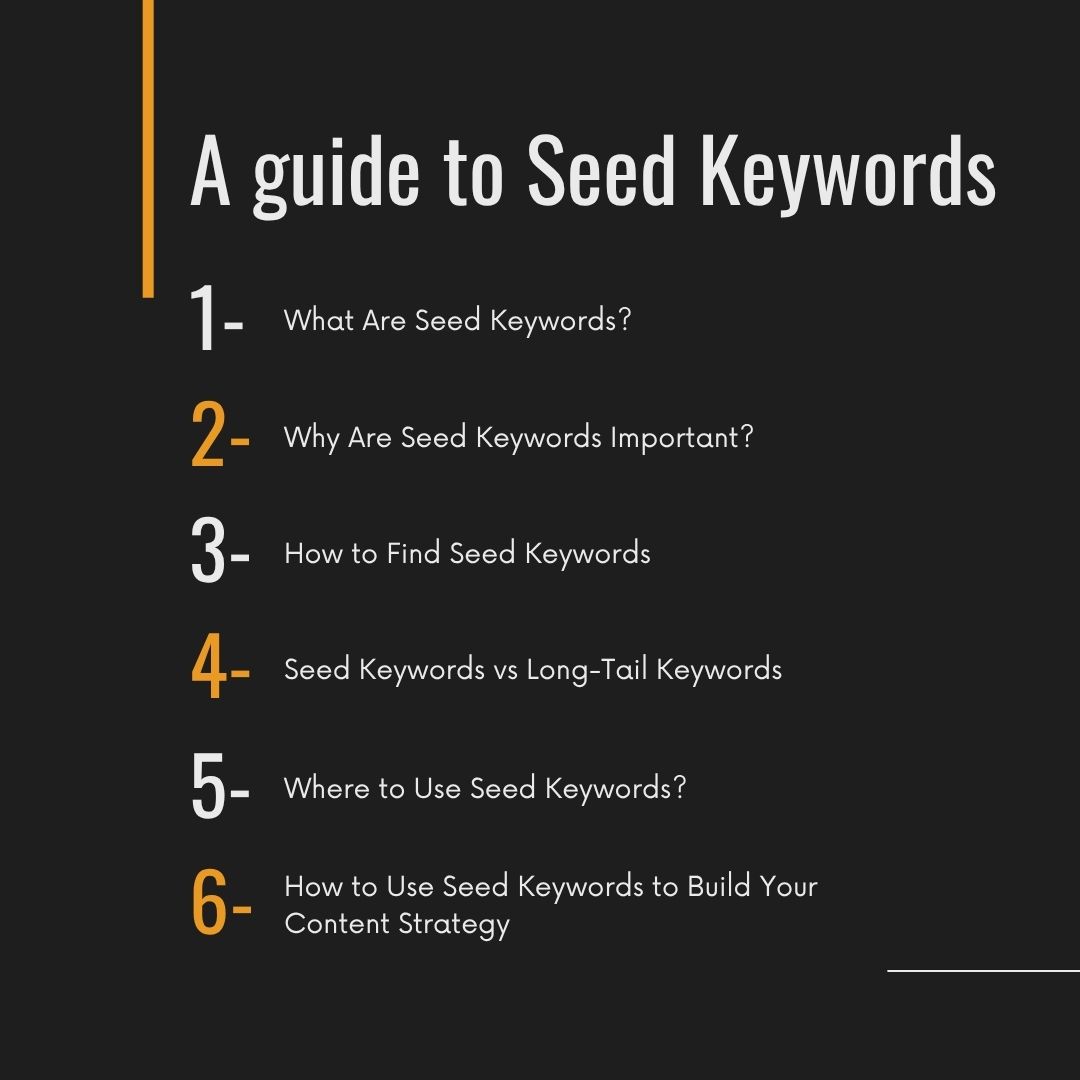
An Easy Guide to Seed Keywords
You know that moment when you’re staring at a blank document, trying to figure out what to write about? Or when you’re building a website and have no idea how to organize your content? That’s precisely where seed keywords come in, and they’re way simpler than they sound.
To understand this better, check out my detailed guide on what keyword research is.
What Are Seed Keywords?
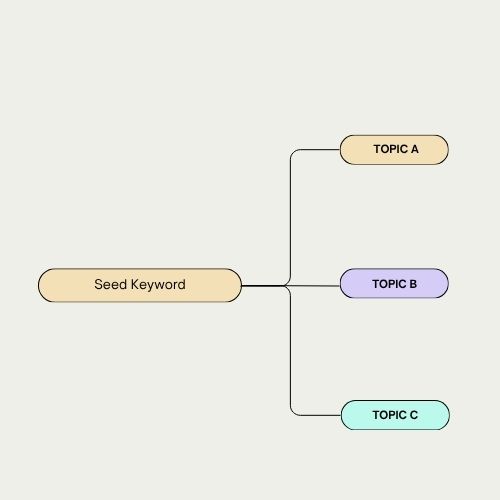
Seed keywords are basic words or phrases that describe what your content is about. They’re the simple terms you’d use to explain your topic to a friend.
Here’s what that looks like in practice:
If you’re building an SEO blog, your seed keyword might be “keyword research.” If you’re creating a fitness site, it could be “home workouts.” For a digital marketing agency? Maybe “content marketing” or “social media strategy.”
See? Nothing fancy. Just broad, straightforward terms that capture the essence of your niche.
Here’s why we call them “roots”: just like a tree grows from its roots, your entire keyword strategy branches out from these seed keywords. They’re not the final destination, they’re your starting line. Every piece of content you create, every page you optimize, every cluster you build traces back to these foundational terms. They literally shape everything that comes next.
Why Are Seed Keywords Important for Keyword Research?
Okay, so you have these basic terms. But why do they matter so much?
They help search engines understand your niche
When you consistently use and build around seed keywords, you’re essentially telling Google, “Hey, this is what I’m all about.” Search engines start recognizing patterns. They see your content isn’t random, focused, relevant, and genuinely useful for people searching in your space.
They guide all your keyword expansion
Seed keywords are your compass. Once you have them, you can expand into hundreds of related terms, questions, and topics. You’re not guessing what to write about anymore. You’re following a map that leads to actual search traffic.
They shape your overall content roadmap
Without seed keywords, you’re basically throwing content at the wall and hoping something sticks. With them? You have structure. You know which topics connect, which ones to tackle first, and how everything fits together. It’s the difference between random blog posts and a content ecosystem that actually grows your visibility.
How to Find Seed Keywords
This is where theory meets practice. You’re not just thinking about keywords, you’re actively hunting them down. Here’s how.
Start with brainstorming
Grab a notebook or open a doc. Ask yourself: If someone needed what I offer, what would they type into Google? What problems are they trying to solve? Write down every term that comes to mind. Don’t filter yourself yet. Just get it all out.
Spy on your competitors (the ethical way)
Examine the websites already ranking in your niche. What keywords are they using in their URLs, titles, and main navigation? You’re not copying, you’re learning what actually works in the real world. Tools like Ahrefs and SEMrush let you peek under the hood and see what’s driving their traffic.
Check “People Also Ask” questions
Type your main topic into Google and scroll down to those expandable questions. These are pure gold. They show you exactly what people are curious about, what gaps exist in the current content, and what angles you haven’t considered yet.
Use the right tools
Google Suggest is free and surprisingly powerful. Just start typing in the search bar and watch the suggestions appear. Keyword Planner gives you search volume data. Ahrefs and SEMrush show you competition levels and related terms. You don’t need all of them, but pick at least one and actually use it.
Go where your audience hangs out
Reddit threads, Quora questions, Facebook groups, and product reviews on Amazon are full of the actual language your audience uses. Pay attention to how they describe their problems, what words they choose, and what frustrates them. That’s your seed keyword goldmine right there.
 Seed Keywords vs Long-Tail Keywords
 Seed Keywords vs Long-Tail Keywords
If seed keywords are so important, why do people keep talking about long-tail keywords? And how do they actually work together?
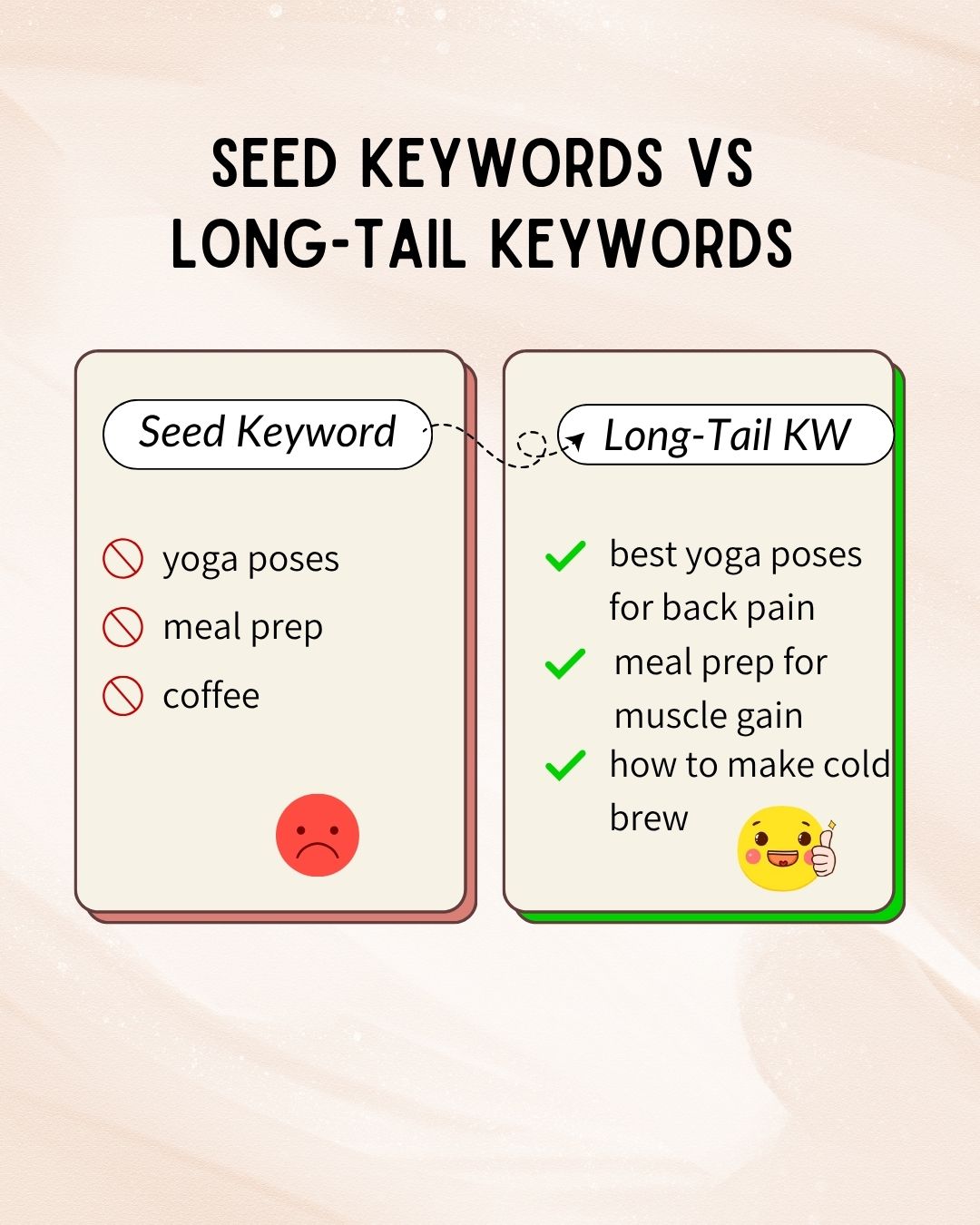
Seed keywords are broad, high-level terms
They usually have high search volume but also high competition. Think “yoga poses” or “meal prep.” They’re generic, but they’re powerful starting points.
Long-tail keywords are specific, detailed phrases
They have lower search volume but also lower competition and higher intent. Learn how to use long tail.
Think “best yoga poses for lower back pain relief” or “meal prep for muscle gain on a budget.”
The key difference? Intent and specificity. Someone searching “coffee” might want anything: coffee shops near them, coffee beans, coffee makers, or the history of coffee. But someone searching “how to make cold brew coffee at home without equipment”? They have a particular need. That’s long-tail.
When to use seed keywords
Use them to organize your site structure, define your main categories, and identify your core topics. They’re your pillars.
When to use long-tail keywords
Use them for individual blog posts, product pages, and specific content pieces. They’re your supporting content that brings in targeted traffic.
Note:
Seed keywords naturally expand into long-tail clusters. Start with “coffee brewing,” and you’ll branch into “French press brewing tips,” “pour over coffee ratio,” “cold brew coffee concentrate recipe,” and dozens more: one seed, infinite possibilities.
Where to Use Seed Keywords?
Now that you have them, where do they actually go? Here’s the practical breakdown.
Website structure and navigation
Your main categories should reflect your seed keywords. If “digital marketing” is a seed keyword, you might have main menu items like “Content Strategy,” “SEO Basics,” and “Social Media Marketing.” This creates a logical hierarchy that both users and search engines can follow.
Content clusters
Build entire sections around each seed keyword. Create a pillar page that covers the seed keyword broadly, then write supporting articles that dive deep into specific aspects. Everything links together, creating a web of related content that boosts your topical authority.
Meta titles and descriptions
Your homepage, category pages, and major landing pages should feature seed keywords in their titles and descriptions. But make them natural, write for humans first, search engines second.
Internal linking themes
When you link between pages, use seed keywords and their variations as anchor text. This helps search engines understand how your content connects and which pages matter most.
Topic ideation
Stuck on what to write next? Look at your seed keywords. What questions haven’t you answered? What angles haven’t you explored? Your seed keywords are an endless source of content ideas.
How to Use Seed Keywords to Build Your Content Strategy
This is where everything comes together. You’re not just writing random articles; you’re building something that scales.
Turn seed keywords into topic clusters
Take one seed keyword and map out 10-20 related topics around it. If your seed is “content marketing,” you might create clusters around “content creation,” “content distribution,” “content analytics,” and “content planning.” Each cluster becomes its own mini-ecosystem of related articles.
Map content around search intent
Not all searches are created equal. Some people want to learn (informational), some want to go somewhere (navigational), some want to buy (transactional), and some want to investigate options (commercial). Match your content to the intent behind each keyword variation.
Prioritize high-opportunity long-tail variations
Use free tools like Google Keyword Planner, Ubersuggest, or AnswerThePublic to find long-tail keywords with decent search volume but lower competition. Google Search Console also shows you the terms for which you’re already ranking. These are your quick wins. They bring traffic faster than trying to rank for ultra-competitive seed keywords right away. Stack these wins, and you’ll build momentum.
Create a scalable content roadmap
Plot out your content months in advance. Start with pillar pages for your main seed keywords, then fill in supporting content around them. Set realistic goals, two pillar pages, and eight supporting articles per quarter. The key is consistency, not perfection.
Here’s what this looks like in action: Picture this – you choose “email marketing” as a seed keyword. You create a comprehensive pillar page covering email marketing basics. Then you write supporting articles on “how to write email subject lines,” “best email marketing platforms for beginners,” “email automation workflows,” and “how to grow an email list.” Each article links back to your pillar page and to the other, where relevant. Over time, Google sees you as an authority on email marketing. Your rankings improve. Traffic grows. And suddenly, that theory you learned is producing real results.
The truth is, seed keywords aren’t complicated. They’re the beginning of a bigger strategy that actually works when you put in the effort. Start simple, stay consistent, and watch your content ecosystem grow from these foundational roots.
People Also Ask
1. How do seed keywords help me create better content?
Seed keywords give your content a clear direction. Instead of guessing what to write, they act as a starting point that naturally expands into related topics, questions, and ideas. This helps you build structured content that actually matches what people search for.
2. What’s the difference between seed keywords and long-tail keywords in simple terms?
Seed keywords are broad terms that describe your main topic, while long-tail keywords are detailed, specific search phrases. Seed keywords help define your niche, and long-tails help you attract targeted visitors looking for very specific answers.
3. Where should I use seed keywords on my website?
You should use seed keywords in your main categories, your pillar pages, your site navigation, and major page titles. They help search engines understand what your site focuses on, making it easier for you to build topical authority.