
SERP Analysis: The Complete Guide to Surpass Your Competitors in SEO
In the competitive world of digital marketing, understanding what makes content rank is no longer optional; it is essential. Whether you’re just starting your SEO journey or looking to refine your strategy, SERP analysis is the compass that will guide your efforts toward success.
Before diving deeper, make sure you also understand the guide to analyzing keyword intent for better rankings, since SERP behavior is directly influenced by what users are truly looking for.
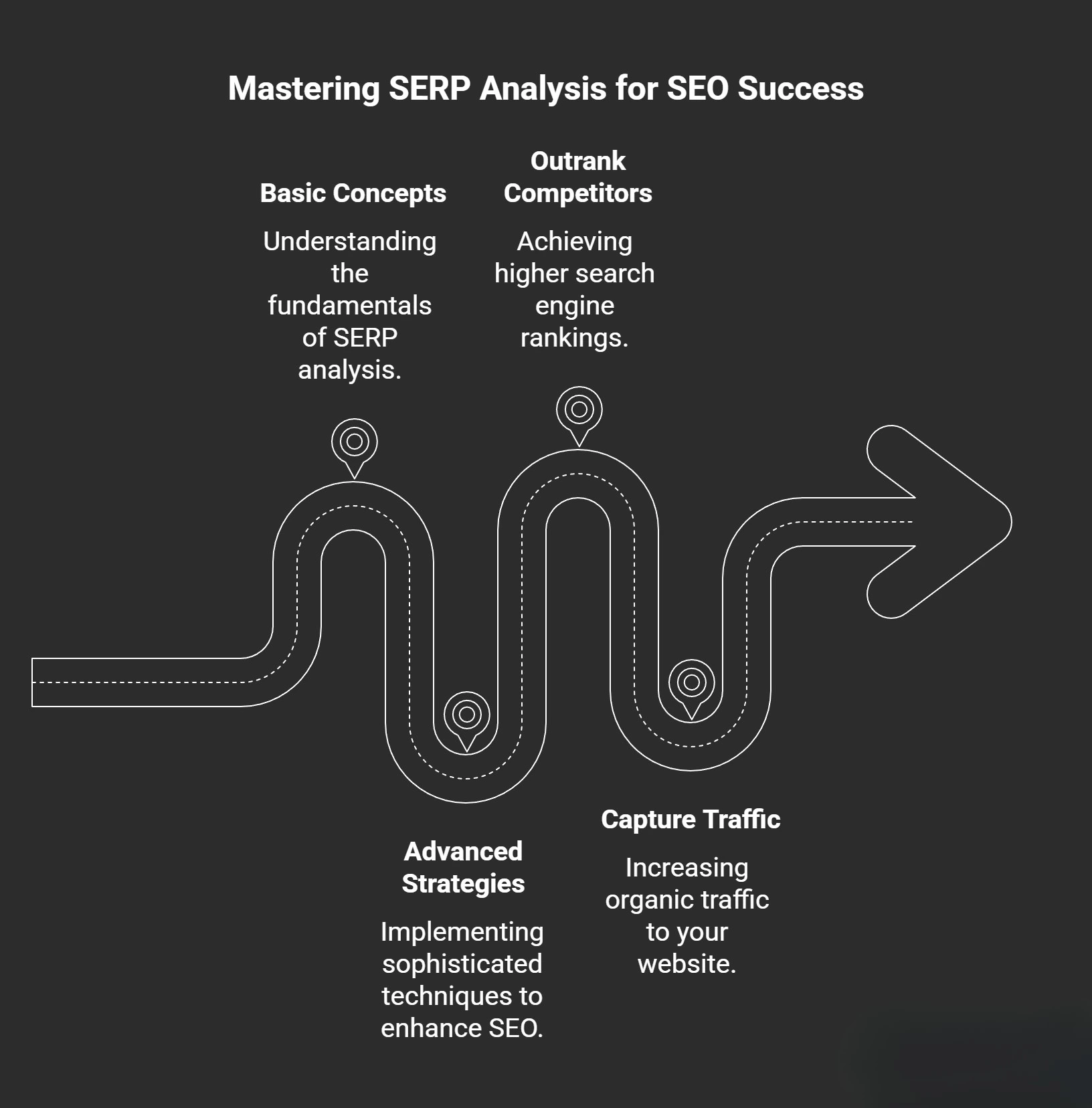
This guide will walk you through everything you need to know about SERP analysis, from basic concepts to advanced strategies that will help you outrank your competitors and capture more organic traffic.
What is SERP Analysis?
SERP analysis is the process of studying search engine results pages (SERPs) to understand what content Google prioritizes for specific keywords. By examining these results, you can gain valuable insights into what Google considers relevant and high-quality for particular search queries.
What SERP (Search Engine Results Pages) Means in SEO
SERP stands for Search Engine Results Page, the page Google shows after you enter a search query. But in SEO, SERPs are much more than just a list of blue links. They’re a complex ecosystem of various elements that Google uses to provide the best possible answer to a user’s query.
Modern SERPs include organic results, paid advertisements, and various SERP features like featured snippets, knowledge panels, and video carousels. Each element serves a specific purpose in Google’s mission to deliver the most relevant information to users.
Understanding how SERPs work is crucial because it directly impacts your visibility online. The higher and more prominently you appear in SERPs, the more traffic you’re likely to receive.
Difference Between SERP Analysis and Keyword Research
While keyword research and SERP analysis are closely related, they serve different purposes in your SEO strategy:
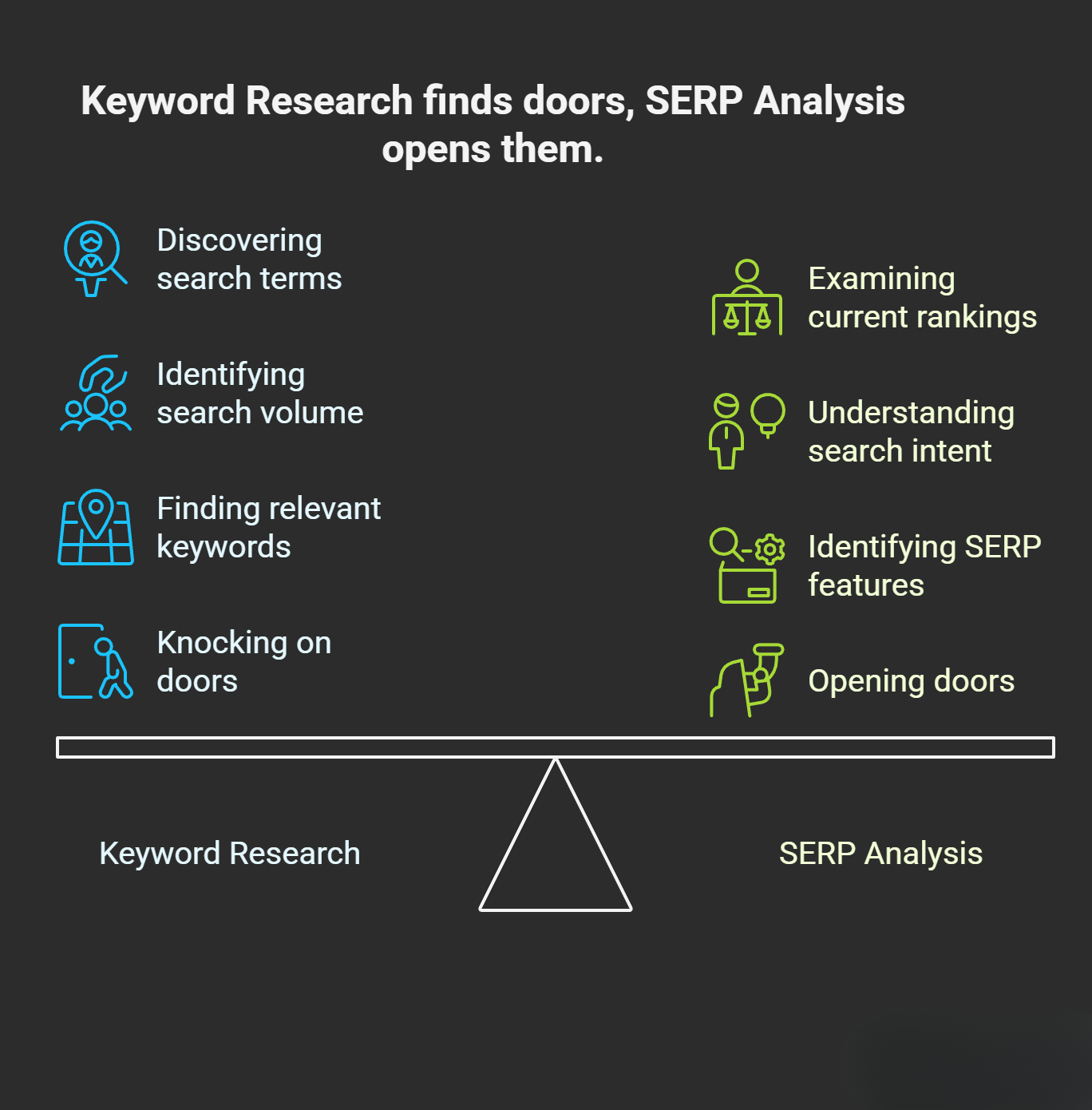
Keyword Research focuses on:
- Discovering what terms people are searching for
- Identifying search volume and competition
- Finding relevant keywords for your content
SERP Analysis focuses on:
- Examining what’s currently ranking for those keywords
- Understanding the search intent behind queries
- Identifying SERP features you can target
- Analyzing competitor content that’s performing well
Think of keyword research as finding the right doors to knock on, while SERP analysis helps you understand what you need to do to get those doors to open.
Key Elements You Evaluate in a SERP
When conducting a SERP analysis, you’ll want to examine several key elements:
- Ranking Pages: What websites are currently ranking in the top positions?
- Content Format: Are the top results blog posts, product pages, videos, or something else?
- Content Length and Depth: How comprehensive are the top-ranking pages?
- SERP Features: Are there featured snippets, People Also Ask boxes, or other special elements?
- User Intent Signals: What do the results tell you about what users are looking for?
- On-Page Elements: What headings, images, and structures do top pages use?
- Backlink Profiles: How strong are the backlink profiles of ranking pages?
- E-E-A-T Signals: How do top pages demonstrate expertise, experience, authoritativeness, and trustworthiness?
By analyzing these elements, you can develop a clear picture of what it takes to rank for your target keywords.
How Search Intent Shapes the SERP
Search intent is the “why” behind a search query, what the user hopes to accomplish with their search. Google has become increasingly sophisticated at understanding and matching search intent, and this directly shapes what appears in the SERPs.
There are four main types of search intent:
- Informational: The user wants to learn something (e.g., “how to fix a leaky faucet”)
- Navigational: The user wants to find a specific website (e.g., “Facebook login”)
- Commercial: The user is researching products before making a purchase (e.g., “best running shoes”)
- Transactional: The user wants to complete an action or purchase (e.g., “buy iPhone 17”)
Google tailors SERPs based on the perceived intent. For example, a search with transactional intent will likely show product pages and shopping results, while informational queries might display featured snippets and in-depth articles.
Understanding the intent behind your target keywords is crucial because it helps you create content that aligns with what users (and Google) expect to see.
The Role of SERP Features (People Also Ask, Snippets, Videos, etc.)
SERP features are special elements that appear alongside traditional organic results. They’re designed to provide users with quick answers or enhanced information directly on the results page.
Common SERP features include:
- Featured Snippets: Boxed answers that appear at the top of the SERP
- People Also Ask (PAA): Expandable questions related to the search query
- Knowledge Panels: Information boxes about entities like people, places, or organizations
- Video Carousels: Collections of relevant videos, often from YouTube
- Image Packs: Groups of images related to the search query
- Local Packs: Maps and listings for local businesses
- Shopping Results: Product listings with images and prices
These features significantly impact user behavior and click-through rates. For example, ranking in a featured snippet can dramatically increase your visibility, even if you weren’t originally in the top position.
By identifying which SERP features appear for your target keywords, you can optimize your content to capture these valuable positions and stand out from the competition.
Why is SERP Analysis Important?
SERP analysis isn’t just another SEO task; it’s a fundamental practice that can transform your entire content strategy. Let’s explore why it’s so crucial for your success.
Helps You Understand What Google Wants to Rank
Google’s algorithm is complex and constantly evolving, but the SERPs provide a window into what Google currently values for specific queries. By analyzing what’s ranking, you can reverse-engineer Google’s preferences.
For example, if the top results for a keyword are all in-depth guides with over 2,000 words, that’s a strong signal that Google values comprehensive content for that query. Similarly, if the top results all include video demonstrations, that suggests visual content is important for that topic.
This insight allows you to align your content with Google’s preferences, increasing your chances of ranking well.
Reduces Guesswork and Improves Content Strategy
Without SERP analysis, creating content is like shooting in the dark. You might have a great idea, but if it doesn’t match what Google and users want to see, it won’t perform well.
SERP analysis transforms your content strategy from guesswork to a data-driven approach. Instead of creating content based on assumptions, you can make informed decisions about:
- What topics to cover
- How to structure your content
- What format to use (blog post, video, infographic, etc.)
- How comprehensive should your content be
- What questions to answer
This targeted approach saves time and resources while dramatically improving your results.
Helps You Match User Intent Perfectly
One of the most valuable insights from SERP analysis is understanding user intent. By examining the types of content that rank for a keyword, you can infer what users are really looking for when they search that term.
For instance, if a search for “best coffee makers” returns mostly comparison articles and reviews, users likely want help making a purchase decision. In contrast, if a search for “how to make coffee without a coffee maker” returns step-by-step guides, users want practical instructions.
By matching your content to the user’s intent, you not only improve your chances of ranking well but also provide a better user experience, which leads to higher engagement and conversion rates.
Reveals Content Gaps and Easy Opportunities
SERP analysis often uncovers gaps in existing content, questions that aren’t being answered well, or aspects of a topic that competitors have overlooked. These gaps represent opportunities for you to create content that stands out.
For example, you might notice that while many articles about “home workout routines” exist, none specifically address workouts for people with limited mobility. Creating content that fills this gap could help you capture a niche audience and potentially rank well for related queries.
Shows What Type of Content Format Dominates
Different queries call for different content formats. SERP analysis reveals which formats perform best for your target keywords.
For some queries, long-form guides dominate. For others, it might be video tutorials, product comparison tables, or step-by-step instructions with images. By identifying the dominant format, you can ensure your content meets user expectations and has the best chance of ranking well.
Helps You Build Pages That Beat Competitors
SERP analysis gives you a blueprint for creating content that can outperform your competitors. By understanding what makes the top-ranking pages successful, you can identify ways to make your content even better.
This might involve:
- Covering topics more comprehensively
- Providing more up-to-date information
- Including better visuals or interactive elements
- Answering questions competitors have missed
- Improving readability and user experience
The goal isn’t to copy your competitors but to learn from them and then create something superior.
Helps You Track Shifts in Google’s Algorithm
SERPs are constantly evolving as Google updates its algorithm. Regular SERP analysis helps you stay on top of these changes and adapt your strategy accordingly.
For example, you might notice that Google has started favoring more recent content for certain queries, or that video results are appearing more frequently for others. These observations can inform your content updates and future strategy.
How to Do Competitive SERP Analysis (Step-by-Step)
Now that you understand the importance of SERP analysis, let’s dive into a practical, step-by-step approach to conducting your own analysis.
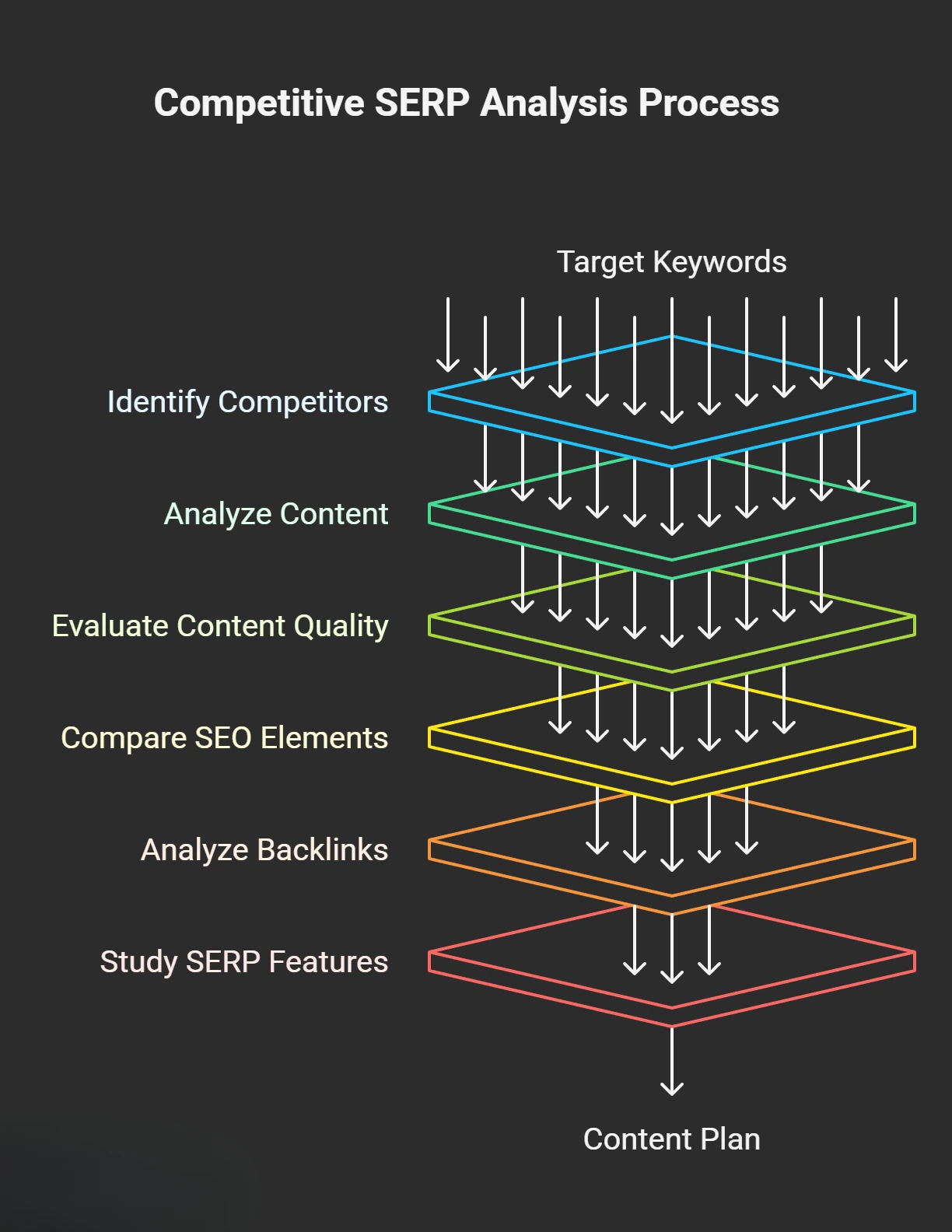
Step 1: Identify Your Real SERP Competitors
Your SERP competitors aren’t necessarily your business competitors. They’re the websites and pages that rank for the keywords you’re targeting, regardless of whether they offer similar products or services.
To identify your SERP competitors:
- Make a list of your target keywords
- Search for each keyword in Google
- Note the top 10 ranking pages for each keyword
- Look for patterns. Which domains appear frequently?
These recurring domains are your primary SERP competitors, and they deserve special attention in your analysis.
Remember that your competitors might vary depending on the keyword category. For example, you might compete with e-commerce sites for product-related keywords but with informational sites for how-to queries.
Step 2: Analyze the Ranking Pages’ Content
Once you’ve identified your competitors, it’s time to analyze their content in detail. This step helps you understand what Google considers valuable for your target keywords.
For each top-ranking page, examine:
- The headline and how it addresses the search query
- The introduction and how quickly it gets to the point
- The overall structure and organization of the content
- The use of subheadings, bullet points, and other formatting elements
- The types of media included (images, videos, infographics, etc.)
- The tone and style of writing
Take notes on common patterns across top-ranking pages. These patterns often reveal what Google considers important for the topic.
Step 3: Check Content Depth, Quality, and Intent Match
Next, evaluate how well the top-ranking content addresses the topic and matches user intent:
- How comprehensive is the content? Does it cover all aspects of the topic?
- Does it answer common questions related to the main query?
- How well does it match the search intent (informational, commercial, etc.)?
- Is the content up-to-date and accurate?
- Does it provide unique insights or perspectives?
- How well does it address the needs of the target audience?
This analysis helps you understand the level of quality and depth required to compete effectively.
Step 4: Compare Word Count, Media Usage, and On-Page
While there’s no perfect word count for SEO success, comparing the length of top-ranking content can provide useful insights:
- What’s the average word count of top-ranking pages?
- How do they use media (images, videos, charts, etc.)?
- What on-page SEO elements do they include (meta descriptions, alt text, internal links, etc.)?
- How do they structure their URLs?
- Do they use schema markup or other structured data?
Remember that quality always trumps quantity. A shorter, more focused piece that perfectly matches user intent will often outperform a longer but less relevant article.
Step 5: Analyze Competitors’ Backlinks and Authority
Backlinks remain a crucial ranking factor. Analyzing your competitors’ backlink profiles helps you understand the level of authority needed to compete:
- Use tools like Ahrefs, SEMrush, or Moz to check the backlink profiles of top-ranking pages
- Note the number of referring domains (unique websites linking to the page)
- Assess the quality and relevance of these backlinks
- Identify potential link-building opportunities for your own content
This analysis helps you develop a realistic link-building strategy based on what’s working for your competitors.
Step 6: Study SERP Features You Need to Target
Identify which SERP features appear for your target keywords and analyze how competitors have optimized for them:
- Featured snippets: What format do they use (paragraph, list, table)? How are they structured?
- People Also Ask: What questions appear, and how are they answered?
- Video results: What type of videos rank, and what makes them successful?
- Image packs: What types of images appear, and how are they optimized?
Understanding these features helps you optimize your content to capture these valuable positions.
Step 7: Look for Weaknesses to Outrank
Every competitor has weaknesses. Identifying these gaps creates opportunities for your content to stand out:
- Outdated information that needs updating
- Missing subtopics or questions that aren’t addressed
- Poor visual elements or page design
- Lack of practical examples or case studies
- Weak or confusing explanations
- Missing data or research to support claims
These weaknesses become your content’s strengths when you address them effectively.
Step 8: Evaluate E-E-A-T Signals of Top Pages
Google increasingly values content that demonstrates Experience, Expertise, Authoritativeness, and Trustworthiness (E-E-A-T). Analyze how top-ranking pages signal these qualities:
- Author credentials and expertise
- Citations and references to authoritative sources
- User reviews and testimonials
- Clear contact information and about pages
- Secure website (HTTPS)
- Regular content updates
Incorporating strong E-E-A-T signals in your content can help you compete, especially in YMYL (Your Money or Your Life) niches.
Step 9: Use SEO Tools (Ahrefs, SEMrush, Surfer, etc.) for Analysis
While manual analysis is valuable, SEO tools can provide deeper insights and save time:
- Keyword research tools: Identify related keywords and questions
- SERP analysis tools: Examine SERP features and ranking patterns
- Content analysis tools: Compare your content with top-ranking pages
- Backlink analysis tools: Evaluate competitor backlink profiles
- On-page SEO tools: Optimize your content based on competitor insights
These tools provide data-driven recommendations that complement your manual analysis.
Step 10: Create a Content Plan Based on Findings
Finally, synthesize your findings into a concrete content plan:
- Outline the structure and format of your content
- List the key topics and questions to address
- Identify opportunities to improve upon competitor content
- Plan your visual and multimedia elements
- Develop a promotion and link-building strategy
- Set a timeline for creation, publication, and evaluation
This plan serves as your roadmap for creating content that has the best chance of outranking your competitors.
Why Tracking SERP Competitors Matters in SEO
SERP analysis isn’t a one-time task; it’s an ongoing process that helps you stay competitive in the ever-changing landscape of search. Let’s explore why continuous tracking is essential.
Helps You Stay Ahead of the Algorithm
Google makes thousands of algorithm updates each year. By regularly monitoring SERPs, you can detect shifts in ranking patterns and adapt your strategy accordingly.
For example, Google has started favoring more comprehensive content for certain queries, and user experience metrics like Core Web Vitals are having a greater impact on rankings. These observations allow you to stay ahead of the curve rather than reacting after your rankings have already dropped.
Helps You Monitor New Competitors Entering the SERP
The competitive landscape is constantly evolving. New players enter the field, and existing competitors update their content and strategies.
Regular SERP monitoring helps you identify new competitors and analyze their approach. This awareness allows you to defend your positions and learn from successful newcomers.
Let’s Help You Understand Why Pages Gain or Lose Rankings
When you track SERPs over time, you can observe which pages move up or down in the rankings and analyze the potential reasons:
- Did a competitor update their content with new information?
- Did they improve their page’s user experience?
- Did they acquire powerful new backlinks?
- Did they optimize for a SERP feature that wasn’t there before?
These insights help you understand what works (and what doesn’t) in your niche, informing your own strategy.
Helps You Maintain Top Rankings
Reaching the top of the SERPs is an achievement, but staying there requires vigilance. Regular monitoring helps you protect your positions by:
- Identifying when competitors are closing the gap
- Recognizing when your content needs updating
- Understanding how user expectations are evolving
- Spotting new SERP features you should optimize for
This proactive approach helps you maintain your hard-earned rankings.
Helps You Adjust Content Faster Than Competitors
In SEO, speed matters. The faster you can adapt to changes, the more likely you are to maintain or improve your position.
Regular SERP analysis gives you early warning signs of shifts in user preferences or algorithm updates. This allows you to adjust your content strategy before your competitors, giving you a competitive edge.
Reveals Shifts in User Behaviour or Intent
User behavior and search intent can change over time, especially for trending topics or seasonal queries. Regular SERP analysis helps you detect these shifts and adapt your content accordingly.
For example, a query that once had primarily informational intent might evolve to have more commercial intent as a topic becomes mainstream. Recognizing this shift allows you to update your content to match the new intent.
Helps You Spot New Keyword Opportunities Early
As you track SERPs, you’ll often discover new related keywords and questions that you hadn’t considered before. These discoveries can inspire new content ideas or updates to existing content.
By identifying these opportunities early, you can create content before competition becomes intense, making it easier to rank well.
FAQs
What’s the difference between SERP analysis and competitor analysis?
While related, SERP analysis focuses specifically on search results pages and what’s ranking for particular keywords. Competitor analysis is broader, examining competitors’ overall marketing strategies, products, pricing, and more. SERP analysis is a component of comprehensive competitor analysis, but with a specific focus on search visibility.
How often should I perform SERP analysis?
For competitive niches, a monthly SERP analysis is recommended to stay current with changes. For less competitive areas, quarterly analysis may be sufficient. Additionally, you should conduct analysis whenever you notice significant ranking changes or after major Google algorithm updates.
Can beginners perform SERP analysis without tools?
Yes! While tools make the process more efficient, beginners can conduct basic SERP analysis using just a web browser. Simply search for your target keywords and analyze what appears in the results: the types of content, the structure of top-ranking pages, and the SERP features present. This manual approach provides valuable insights even without specialized tools.
What tools are best for SERP analysis?
Popular tools for SERP analysis include SEMrush, Ahrefs, Moz, Surfer SEO, and Mangools. Google’s own tools, like Search Console and Analytics, also provide valuable data. The best tool depends on your specific needs and budget. Many offer free trials or limited free versions that can help you get started.
Does SERP analysis help with Featured Snippets?
Absolutely! SERP analysis is essential for featured snippet optimization. By analyzing which content currently holds the snippet position, you can understand the format (paragraph, list, table) and structure that Google prefers for that query. This insight allows you to optimize your content specifically to capture the featured snippet.
Is SERP analysis beneficial for local SEO?
Yes, SERP analysis is particularly valuable for local SEO. It helps you understand which local businesses rank in the Local Pack, what information Google displays about them, and what factors might influence local rankings. This analysis can guide your local SEO strategy, from Google Business Profile optimization to local content creation.
SERP analysis is your window into what Google values and what users expect. By making it a core part of your SEO strategy, you’ll create more effective content, adapt more quickly to changes, and ultimately achieve better rankings and more organic traffic.
Remember that SEO is both an art and a science. While SERP analysis provides valuable data, successful optimization also requires creativity, quality content, and a deep understanding of your audience’s needs. Combine these elements, and you’ll be well on your way to surpassing your competitors in the SERPs.
Want to level up your keyword game? Dive into these powerful insights for understanding intent with examples and start crafting content that actually get you traffic.